-

"hasn't everything been said already..?!"
Important messages by past VIP'sZarathustra, da Vinci, Michaelangelo, Jordans, Kant, Wild, Heuss, Menuhin, Postman, Eibl-Eibesfeldt
BC
Zarathustra (1000 BC)
There is only one path towards redemption and perfection: not an escape from the world, rather a cleansing of the world, an overcoming of the world or overcoming oneself and that means; the constant inner fight against ones base nature, which means, against untruth, impure thoughts, feelings, plans, goals, words and deeds. Only though this can man receive harmony, peace, consciousness, knowledge of oneself, wisdom and joy.AC
Leonardo da Vinci (1452-1519)
A realisation that doesn’t pass through the mind cannot result in any truth but a damaging one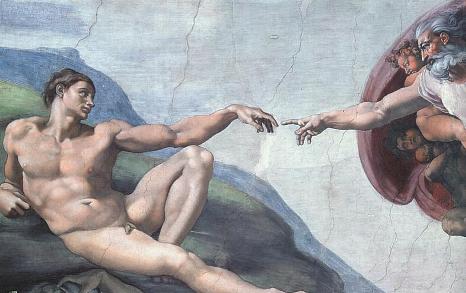
Michaelangelo Buonarotti (1475-1564) - The Creation of Adam
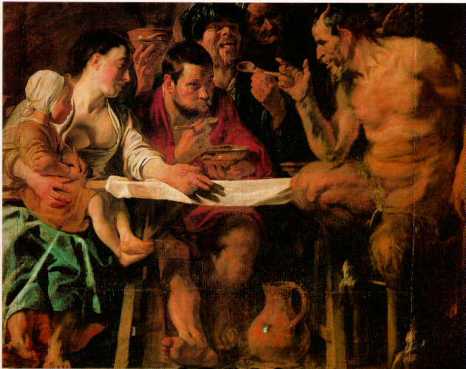
Jacob Jordans (1593-1678) - Satyr and Peasant (1620)Immanuel Kant, (1727-1804)
Man is defined by his logic, existing in a society with other people and in it to cultivate himself through art and science, to civilise and to moralise; however insurmountable his bestial tendencies may be, to resist the temptation of comfort and of luxury. Thereafter man must be educated in goodness.Oscar Wilde (1854 - 1900)
The secret of life lies in the search for beauty.
Those who discover good intentions in beautiful things have culture. They are our hope.Prof. Dr. Theodor Heuss (1884-1963)
(West German President 1949-59) Politics can not determine culture, but culture can determine politics.------------------------------------
With warm wishes to the United World Philharmonic Youth Orchestra
from
Irenäus Eibl-Eibesfeldt (1928 - )
excerpts from his book
Costs of Freedom - Limits of Security
(Publisher Rüegger - Zürich/Chur)
the trap of short-term thinking - our programming on the competition at present
short resumé
We are a part of the most successful species. But our success is demanding new challenges of adaptation because we,
within our work-sharing millions-strong society and our technical civilisation,
created an environment where our historical roots are not sufficientely adapted.
For the longest period of time in our history we lived on a level of stoneage dear hunters. Our emotions and way of thinking are stone aged based and created for a life as a family connected personal contact and related small-group adopted,
which are territorially separated.
On a cutural basis we are able to extend the family small-groups-ethic into friendly larger groups,
which are linked between many alliances.
There are behavior-dispositions which contribute and others which produce conflicts
in special situations.
A very old stoneaged programming is our competition based behaviour of dominant
effort with its concentration on the competition at present.
This prevents sustainable behavior in daily action!
At present within the global framework of globalization mentioned competition, which has been rightly critisized as
“predator-capitalism”, is trying to legalise itself with the power of nature which knows no mercy.
That is true in many cases, but is obviously not the rule. Even vertebrates, which show no prosocial behavior, developed a non-blood competition of forces within ranking-fights, because it developed as an advanged.
Mammals in addition developed, related to evolution, the individual caring behavior and motivation as well as the capability of
individual relations, which opened new opportunities for kindness, love and empathy which made permanent co-habitation possible.
Because of our ability of speech we are aditionally able to overcome our emotionally based behavior of the dominant, at present, as we have the imagination and awareness of the past and the present.
That is why we are also able to develop a generation related survival-ethic,
which finally will achieve the goal of happiness of future generations.
Based on the eco-social market economy we are on a good track to live in peace with nature and mankind, although,
we are open to corrections of our mistakes on our way to this goal.
The counter-productive, within the framework of globalization, mistakable development of farming, industrialisation and commerce as well as the problems as a result of requests of unlimited open borders for immigrants has been reflected, and a concept of the eco-social area of peace has been confirmed.
Translation german to english by Christopher Pearce
__________________________________________________________________________________
In Memoriam
Best wishes to the project from Neil Postman, October 20, 1999
“Of course, it is to late in the year for me to involve myself in the Convention (Cop5, UNFCCC), but it all seems both exciting and worthwhile. Perhaps I could connect with you in the future.”
Forward “We are amusing ourselves to death“
by Neil Postman
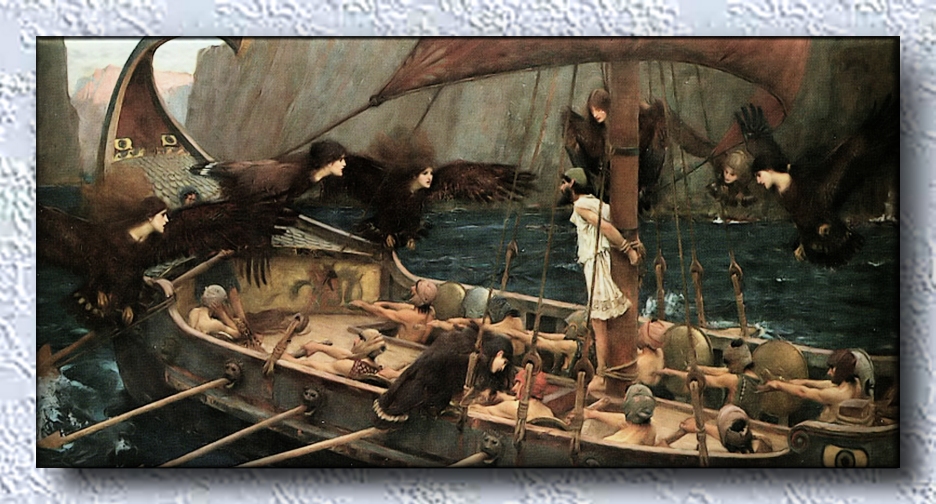
- Ulysses and the Sirens -
by John William Waterhouse
with courtesy of National Gallery of Victoria
www.ngv.vic.gov.au
www.bridgemanart.comWe were keeping our eye on 1984. When the year came and the prophecy didn't, thoughtful Americans sang softly in praise of themselves. The roots of liberal democracy had held. Wherever else the terror had happened, we, at least, had not been visited by Orwellian nightmares.
But we had forgotten that alongside Orwell's dark vision, there was another - slightly older, slightly less well known, equally chilling: Aldous Huxley's Brave New World. Contrary to common belief even among the educated, Huxley and Orwell did not prophesy the same thing. Orwell warns that we will be overcome by an externally imposed oppression. But in Huxley's vision, no Big Brother is required to deprive people of their autonomy, maturity and history. As he saw it, people will come to love their oppression, to adore the technologies that undo their capacities to think.
What Orwell feared were those who would ban books. What Huxley feared was that there would be no reason to ban a book, for there would be no one who wanted to read one. Orwell feared those who would deprive us of information. Huxley feared those who would give us so much that we would be reduced to passivity and egoism. Orwell feared that the truth would be concealed from us. Huxley feared the truth would be drowned in a sea of irrelevance. Orwell feared we would become a captive culture. Huxley feared we would become a trivial culture, preoccupied with some equivalent of the feelies, the orgy porgy, and the centrifugal bumblepuppy. As Huxley remarked in Brave New World Revisited, the civil libertarians and rationalists who are ever on the alert to oppose tyranny "failed to take into account man's almost infinite appetite for distractions". In 1984, Huxley added, people are controlled by inflicting pain. In Brave New World, they are controlled by inflicting pleasure. In short, Orwell feared that what we hate will ruin us. Huxley feared that what we love will ruin us.
This book is about the possibility that Huxley, not Orwell, was right.
--------------------------------------------
In Memoriam
A Message to the world from the honorable Lord Menuhin (1916-1999)
Lord Menuhin: I am happy to be able to greet my young colleagues of the United World Philharmonic on this great occasion, their own inaugural concert, but happening also in Kyoto to inaugurate the climate change conference.
I am very satisfied, as a man of 81, and reassured, that my younger colleagues Chloe Hanslip and Keisuke Okosaki and all the members of the orchestra from all over the world are showing such a sense of responsibility and dedication, and working with their music and their heart for a better environment, for a better future, for the future of their children.
I take this opportunity of greeting the delegates from all over the world who are coming for this important climate change meeting. I wish them good luck. I think that anyone who stands in the way of the severe, urgent and very quick reduction of the gases emitted by our WC-civilisation ... I hope that they will not find too much resistence because people who stand against that are, in fact, no less than criminals who would inflict cancer on the whole of mankind. In fact all you have to do is visit Mexico City to see where 14 million people are dying of that now.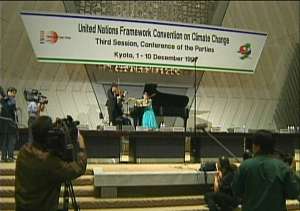
Members of the UNITED WORLD PHILHARMONIC in Kyoto 1997
at the UN-CONVENTION ON CLIMATE CHANGEInterviewer: Can you say something about the problem of soil erosion? We have to think about the developing world, especially Africa.
Lord Menuhin: Owing to our own western great advance in technology and owing to the preponderance we have in terms of equipment, money, weapons, we are not aware of the penalties that the rest of the world is paying for our temporary well-being.
We are dispoiling the earth of its cover, of its green, of its forests. We are poisoning the oceans, and the waters. We are allowing every kind of erosion to take place, not least the erosion of our own sensibilities, our own hearts, and we live more and more in the narrow, ever more bitter concept of the future instead of opening up and doing all we can to help the Third World and all who suffer and all who will suffer as a result of our own ruthlessness, who persist in putting up barriers to every sensible suggestion. We will soon be paying ourselves for this lack of foresight and of understanding.Interviewer: Do you think that we can find solutions together with the United Nations?
Lord Menuhin: Yes. I think solutions, or at least a retardation of the speed with which the menaces are crowding in around us, must start with a re-education of children. This is not difficult.
We think that we can control crime with police and prisons but we are producing it every day. We allow children's minds to be filled with horrific images which crowd out even the advertisements with which they would like to persuade children to buy post-toasties. And we see violence creeping ever closer, ever more distressing, the streets, one-parent families, attachments to earth, to people, to families broken.
This is a poison that is contagious and it can only be broken by learning that our neighbour can be of great help to us - especially when we are sick and we need him. And that our neighbour is not necessarily an enemy, and if we bring them encouragement, help, goodwill, if we spread trust in the world instead of spreading fear we would be surrounded by friends.
If we did not make Nature into an enemy, Nature too would heal - and help us heal - ourselves. There is perhaps hope but for that we have to change the thinking and the feeling of a good part of mankind.Interviewer: Do you think it is true to say that it will still take mankind 500 years to be further developed than monkeys?
Lord Menuhin: We don't have 500 years. Without education, and if we let things drift as they are now, I don't think we have 500 years. I think that we must act immediately. The dangers are too close and they have already taken their toll in many parts of the world. There are parts of the world that are on the verge of famine, or have famine. There are parts that are diseased, there are parts where there are no trees growing. There are many peoples, and many races, and many species who have become extinct.
So that the fact that we can still look forward to tomorrow's meal does not mean that these menaces will not be upon us the day after tomorrow. What happened in Yugoslavia could easily happen in Belgium - or anywhere else. And it is not only a matter of thinking wrong, of being encouraged to vengeance for the purposes of building up the vanity of some leader, but it simply is a general worldwide ruthlessness that has come to a certain extent with this childish assumption that capitalism has won.
Capitalism produces enormous energy and releases wonderful ambitions. But it also has its limits when it comes to the sale of drugs and arms and the ruthlessness with which it pursues its aims in the Third World. Therefore we have to have a mixture - not in opposition - but a cooperative, complementary mixture of those who give us energy - the capitalists, and those who give us protection - the socialists. Unless we have a mixture of the two we cannot hope to live in a civilised society.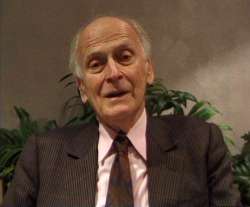
The honorable Lord MenuhinInterviewer: What part can classical music play in educating mankind?
Lord Menuhin: Well, I am actually more interested in children singing themselves, singing and dancing. Yes: folklore, classical chorales, religious music, folk music of every kind from every part of the world - that is very effective. I think just listening passively is not sufficient.
Interviewer: To be active.
Lord Menuhin: Yes.
Interviewer: Do you think the change for a better world should come from the individual in principle- as a grass-root movement?
Lord Menuhin: I think it will come from individuals. I don't think it will come from governments. I think it will come from groups of people who are convinced and non-governmental organizations and from private people and modest people like a wonderful little group in Switzerland that calls itself "Un pays - deux peuples" - "One country - two people" and always one Israeli woman and one Palestinian woman go together.
The world will change when people will understand their enemy, when they will forgive them and when they will realize that we are interdependent, that the tragedy of one people, or one part of the world, is as if it were our own. We cannot be happy any more than the Israelis can be happy when the Palestinians are unhappy. That's just the situation we are in. I don't think it's impossible.
Look at South Africa with its sudden change from the harshest injustice to a regime of justice. Of course, they had the advantage of a great leader who himself survived 17 years in prison and was able to forgive. That is a wonderful example. Our leaders unfortunately were not formed that way. It would have been very good if they had been.Interviewer: You were always a leading personality for society, a guide.
Lord Menuhin: No, not a guide but simply one who felt very deeply for the ills of mankind, and for the sadness of people who lacked compassion and for the desire just to see people understand each other. Our century has produced such disasters. And the fact that people who behaved in an unacceptable way are people who today are the most civilised and that terrorists have become Nobel prize-winners simply proves that we are redeemable - that if we are ready to confess, if we are ready to mature, then we are redeemable, we can do good things.
But there are so many vested interests in keeping us ignoble and, in the wrong sense, ambitious and ruthless - everything around us, all the advertisements, the names of cars - it's all aggressive, it's all trying to impose ourselves as macho men.
It begins in the home. The greatest part of the population of the world that is exploited and abused are women - and children. They should have a voice too. But I think contracts that deal with money have no heart and yet they should have.
The person sitting in an office in New York is very, very far away from the native in Senegal, in Tansania. He only sees his books and says "We're not making enough profit". And he isn't a bad man. If he were himself there he may himself be a very generous and good man. But the separation of mankind into categories, this kind of forced order, "he's a banker and he must make a success of that, he's an industrialist, he's a priest, he's a musician"; and we all depend on each other.
The banker won't survive any number of bunkruptcies and disasters himself. In fact now, in the hopes of making money very quickly, they accorded credits for industrial purposes, and airlines, and steelmills to countries that were not ready and couldn't pay for it. And now the whole economy of Japan and no doubt the western countries will suffer for having given money credits - in order to keep our own industries going - which shouldn't have been given. If they had given help to these people in terms of real restoration of their irrigation, their water, their well-being, their health - if that had been done instead, we'd have had grateful friends.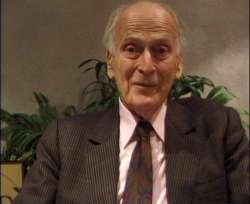
The honorable Lord MenuhinInterviewer: Compared with your own youth, do you think Chloe has a harder life now? a harder development for her career?
Lord Menuhin: I don't think so. I think gifted violinists, gifted instrumentalists, with much to communicate will have the opportunity of doing so, I am sure. I really do feel that.
I know that all musicians who go out of my school are doing all very well.Interviewer: Are the marketing departments of record companies and so on a danger because they just promote musicians?
Lord Menuhin: The danger of the "classical world" is that we have exploited Beethoven without putting anything back. We are playing him all the time, he's becoming banale, and instead of being deeply moved by his music and playing it as it should be, we hear it in any which way.
In fact I've been to hotels where they put in the rooms the Beethoven Ninth or "Emperor" Concerto without even giving the names of the orchestras or the performers. It's just like company names for fruit. You get bananas - and they carry a company name. They don't even tell you whether they come from South America or Africa - it's just the company name.
And so it's becoming more and more anonymous - and who wants to hear an anonymous performance of a work of Mozart or Debussy or Wagner? They only play the notes - that's anonymous. But people who buy it, buy the Ninth Symphony. They think they have it in the bag.Interviewer: From a marketing standpoint it's easier to have a fast career in this media world but for the development of the soul of an artist it has become more difficult. Do you agree?
Lord Menuhin: I know. The only criteria at competitions are those that hold for the Olympics, that is speed and you can measure loudness.
But there are other values in music. What often is ignored in music is economy, whereas in sport economy of motion, economy of energy spent, is of the greatest importance. Very often you see violinists sweating away, with no elegance or economy of performance, and with no sense of style for the work they are interpreting. And more and more orchestral musicians look bored when they play, and conductors go through the motions.
But if you played, if you heard, as I have recently played with orchestras and young people, or spontaneous orchestras composed of a teachers' conference - because I am President of the European String Teachers Association and the English String Teachers (we had a meeting last Sunday) and they said "Now we must play something!". And they played with such devotion and beauty of feeling - it was quite extraordinary. Those were real musicians. But in that case they behaved like amateurs because they were teachers, they weren't orchestral musicians. And the professionals behave like bored people who are not interested in their profession.Interviewer: They are frustrated?
Lord Menuhin: Frustrated? Yes, yes.
Interviewer: Human society must reflect more about itself to see what should be achieved, and to re-evalutate its goals. Do you think that our concept to use classical music as a messenger in this sense is correct?
Lord Menuhin: I think so. I think music is a wonderful messenger, that's true. But I think we have a little too much faith perhaps in just an isolated concept.
What we need is singing and dancing in all the schools every day, every morning, folklore of every country, chorales from different religious sources. That's what we need.Interviewer: To rediscover the right spirit?
Lord Menuhin: Yes.
Interviewer: And for a better society?
Lord Menuhin: I hope.
Interviewer: I thank you very much.
Interview by Rüdiger Schramm/ Brussels, November 1997
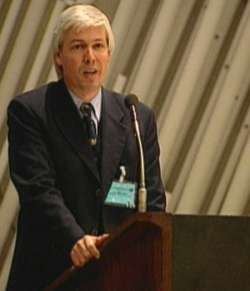
Rüdiger Schramm speaks to the UN-Delegates in Kyoto
at the Convention Hall about the orchestra concept.